Most people with osteoporosis don’t know they have it. Bone loss has no symptoms, and a lot of people never get a bone-density (DXA) scan until after something breaks. So here’s a genuinely encouraging idea: what if the chest X-ray you already had for something else could flag it?
That’s what radiologists at Seoul National University Bundang Hospital set out to test. Their paper was published on 9 October in npj Digital Medicine. They trained an AI model, called AI-OsRM, on 46,478 chest X-rays, each paired with a DXA scan of the same person, from 26,757 patients seen between 2016 and 2022.
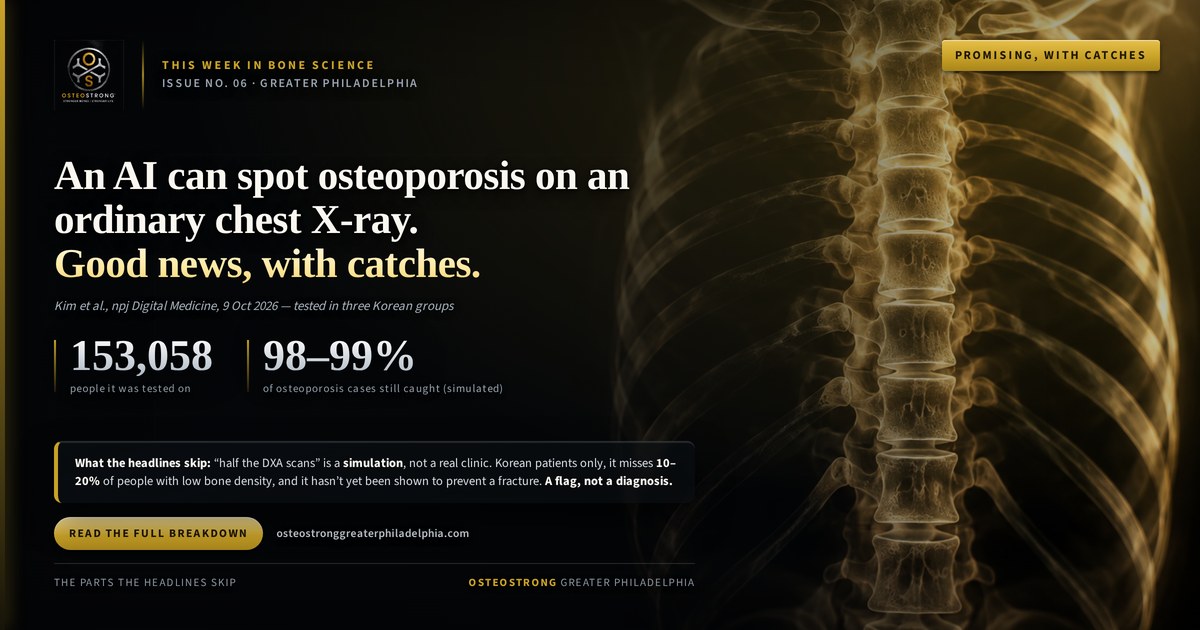
Then they did the important part: they tested it on people it had never seen. There were three separate groups, 153,058 people in total: a later group from the same hospital (6,391 people) and two large health-checkup groups (24,132 and 122,535).
It did well. On the usual accuracy scale, where 1.0 is perfect and 0.5 is a coin toss, it scored 0.88 in the hospital group and 0.93 and 0.92 for osteoporosis in the two checkup groups. Those are strong numbers, and they held up across all three groups.
The researchers also ran a simulation. If the model were used as a first filter, deciding who gets sent for a DXA scan, about half as many scans would be needed, and 98 to 99% of people with osteoporosis would still be sent for one.
A flag, not a diagnosis. And a good flag is worth having.
What still has to be proven
None of that makes it bad news. It’s an early, well-built piece of work, and the next step is the one that counts: a real-world trial. Tools like this could eventually find people years before a fracture finds them, using scans that already exist.
In the meantime, it doesn’t replace a bone-density scan. It helps decide who should get one. If you’re over 50, especially a woman after menopause, you don’t need to wait for an algorithm to suggest it. Ask about your bone density, and learn what the number means.
Also this week: our No.03 study made NEJM Journal Watch
On 7 October, NEJM Journal Watch reviewed the BMJ analysis of 124 exercise trials we covered in No.03. Their clinical takeaway: brisk walking or jogging was the most effective option for bone density in that analysis. It’s worth repeating what we said then. The gains were modest, the authors rated most of their estimates low to moderate certainty, and most trials lasted only 6 to 12 months. It shouldn’t be read as ‘walking beats lifting.’ Moving matters, and how much load your bones need is still being worked out.
If you want the underlying mechanics — what bone density measures, what it misses, why load is the signal, and how to read your own report — that is what Boneprint Academy is for. 71 lessons, 890 citations, completely free, no signup required.
Open Boneprint AcademyFounder & CEO, Vital Edge Wellness · Owner, OsteoStrong Greater Philadelphia
Sources
- Kim Y, Lee DH, Byeon S, Cho HS, Jo S, Park CM, Lee JW, Chung M, Nam JG. Artificial intelligence for opportunistic osteoporosis screening on chest radiographs. npj Digital Medicine. Published online 9 October 2026 (accepted manuscript). doi:10.1038/s41746-026-03333-7
- Post SE. Exercise and bone density: does modality matter? NEJM Journal Watch / NEJM Clinician, 7 October 2026 (reviewing Lu et al., BMJ 2026;394:e100561).