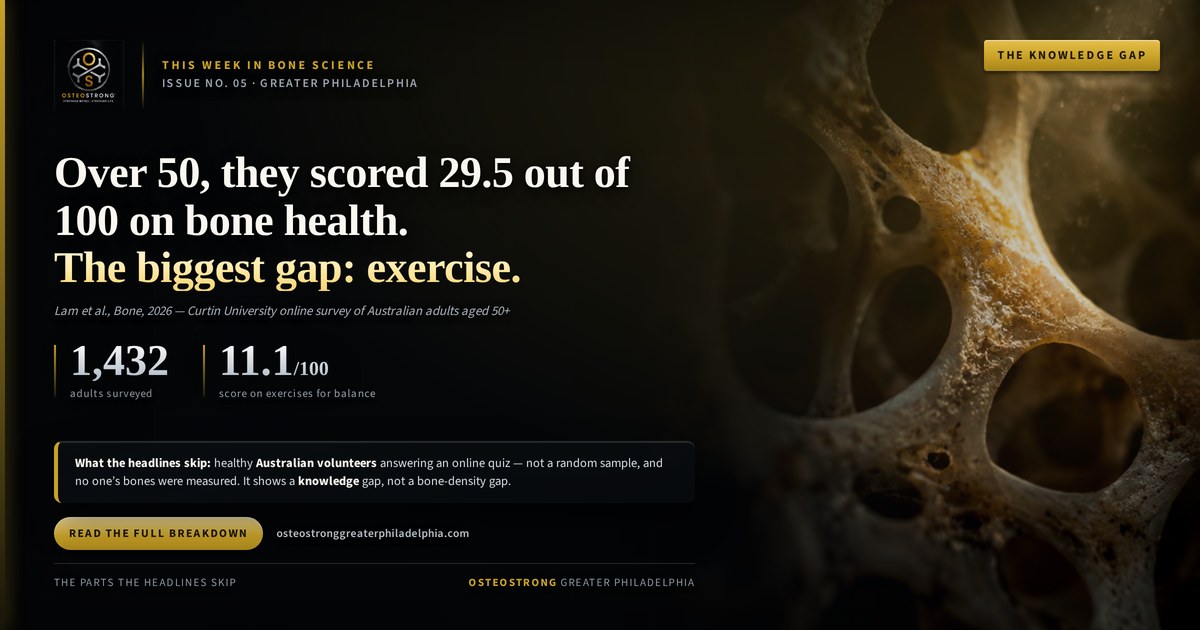
Researchers at Curtin University in Western Australia asked 1,432 adults aged 50 and over what they know about osteoporosis — risk factors, calcium, exercise, balance. The paper is in the journal Bone. The average score was 29.5 out of 100.
The biggest gap wasn’t calcium, and it wasn’t hormones. It was exercise. According to the university, more than half of participants could not identify the types of exercise — resistance training among them — that help protect bone, and more than a third could not identify the kind of exercise that improves balance and reduces the risk of a fall. In the paper itself, ‘exercises to improve balance’ was the lowest-scoring topic of all (11.1 out of 100); ‘sources of calcium’ was the highest, at 35.
Only 18% said they paid a lot of attention to reducing their osteoporosis risk — even though 30% of the women and 13% of the men reported a family history of it. Just 4.5% ranked osteoporosis as their biggest health worry. Men were 2.4 times as likely as women to land in the lowest-knowledge group; so were people with less formal education and people with no family history to prompt them.
But one part holds wherever you live: you can’t act on a risk nobody has explained to you. Bone loss has no symptoms until something breaks. If more than half of adults over 50 can’t pick out the kind of exercise that loads bone, that isn’t a motivation problem. It’s an information problem — and it’s the one that’s easiest to fix.
You can’t act on a risk nobody has explained to you.
An AI that flags hip-fracture risk years ahead
The second paper, in PLOS Medicine, comes from Sweden. Researchers built a machine-learning tool called FRACTURE-ML from national health-registry data on 3,542,647 people aged 50 and over — everyone in the country who wasn’t already on osteoporosis medication. Over the follow-up, 142,327 of them broke a hip.
Its accuracy was high: an AUC of 0.89 for predicting a hip fracture one year out (1.0 would be perfect; 0.5 is a coin toss), and 0.85 at five years for a slimmed-down 35-variable version. Compared with Sweden’s current approach — which mostly finds people after a first fracture — it identified nearly seven times as many of the people who went on to break a hip (sensitivity 0.84 versus 0.12).
Still, the direction is clear, and it raises the obvious question. If a model can tell you five years ahead, what exactly are you meant to do with those five years?
Prediction isn’t prevention.
That’s the harder half of the problem, and nobody is building an algorithm for it: loading the skeleton, holding on to muscle, practising balance, eating enough protein.
Where this leaves you
Two honest conclusions. Most adults over 50 in one large survey couldn’t name the basics of protecting their own bones — especially the exercise. And the tools for predicting fractures are racing ahead of anything that tells people what to do next.
Neither paper changes what works. Both are a good reason to find out where you stand and to learn the mechanics before something breaks.
If you want the underlying mechanics — what bone density measures, what it misses, why load is the signal, and how to read your own report — that is what Boneprint Academy is for. 71 lessons, 890 citations, completely free, no signup required.
Open Boneprint AcademyFounder & CEO, Vital Edge Wellness · Owner, OsteoStrong Greater Philadelphia
Sources
- Lam PD, Dhaliwal SS, Pollard CM, Jancey JM, Prince RL, Kerr DA. Knowledge, intentions and attitudes towards osteoporosis and other health conditions among older Australians. Bone 2026;213:118042. Epub 14 August 2026. doi:10.1016/j.bone.2026.118042
- Curtin University media release: Older Australians in the dark about osteoporosis, Curtin research finds. 27 August 2026.
- Axelsson KF, Litsne H, Konstantinou K, Khalid H, Pivodic A, Lorentzon M. A clinical decision support tool for accurate hip fracture prediction: a nationwide cohort study. PLoS Med 2026;23(8):e1005190. Published 27 August 2026. doi:10.1371/journal.pmed.1005190