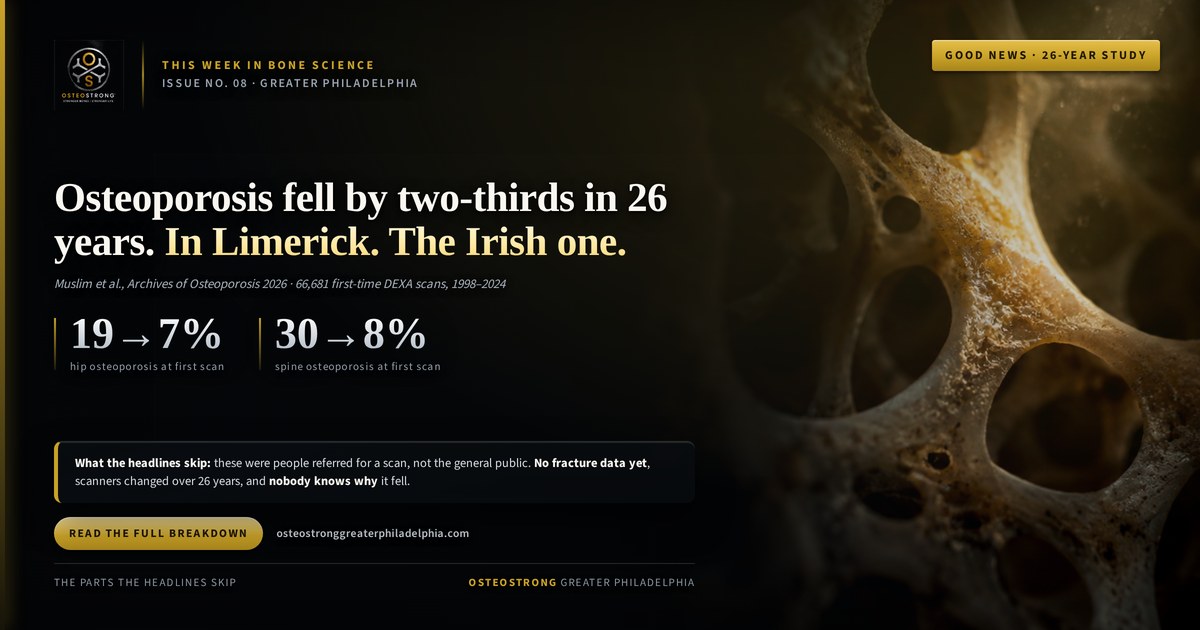
Here’s some genuinely good bone news, from a town with a familiar name. Researchers in Limerick, Ireland looked back at every first-time bone-density (DEXA) scan done at two local hospitals between 1998 and 2024. That’s 66,681 people, about 4 in 5 of them women, with an average age of 61.
Over those 26 years, the share of people who already had osteoporosis at their first scan dropped by roughly two-thirds. The study was published in Archives of Osteoporosis and is free to read.
Why it’s more than a headline
The researchers did a few things right. They only counted each person’s first scan, before any treatment, so people improving on medication don’t muddy the picture. They adjusted for age and sex, so it isn’t just younger people getting scanned. And they checked whether the drop came from scanning more people. Even after all that, each year brought about 3–5% lower odds of osteoporosis at the hip and spine.
Average bone scores rose too. The typical hip T-score improved from −1.26 to −0.68, and the spine from −1.66 to −0.31. In other words, people are arriving at their first scan with stronger bones than they did a generation ago.
Bone health isn’t fixed by the year you were born. Across a whole region, it moved.
The catches
The lead author, Dr Azrin Muslim, put it fairly himself: the results “do not mean osteoporosis has ceased to be a significant health problem, nor do they show that fractures will necessarily decline at the same rate.”
Also this week: should your first scan be at 50?
On 20 October, NBC News ran a piece with Duke orthopedic surgeon Dr Jocelyn Wittstein. She noted that women lose about 10% of their bone density from two years before menopause to about a decade after, and suggested a first DEXA scan at 50 rather than 65. US guidelines currently recommend screening at 65, or earlier for postmenopausal women with risk factors. Her view is an opinion, not new data. But it fits the Limerick story: you can’t see a trend in your own bones without a starting number.
What to do with this
The encouraging part is that whole populations can shift toward stronger bones. Your own bones respond to the same things the researchers mention: regular weight-bearing exercise and load, enough calcium and vitamin D, not smoking, and going easy on alcohol. If you’re a woman around menopause, or anyone over 50 with risk factors, ask your doctor about a baseline scan. Then you’ll have a number to improve on.
If you want the underlying mechanics — what bone density measures, what it misses, why load is the signal, and how to read your own report — that is what Boneprint Academy is for. 71 lessons, 890 citations, completely free, no signup required.
Open Boneprint AcademyFounder & CEO, Vital Edge Wellness · Owner, OsteoStrong Greater Philadelphia
Sources
- Muslim A, Fallon E, Mohd Asri NA, Costelloe A, Sheehy T, Griffin M, Lyons D. Secular trends in osteoporosis prevalence at first presentation over 26 years in a regional Irish DEXA registry: a retrospective repeated cross-sectional analysis. Archives of Osteoporosis 2026;21:122. Published 19 August 2026. doi:10.1007/s11657-026-01764-z
- HSE Mid West. Mid West study finds people are reaching older age with healthier bones. 8 September 2026.
- Griffin N. Researchers find ‘substantial’ drop in number of Irish people developing osteoporosis. Irish Examiner, 23 October 2026.
- Duke Health surgeon says women’s rapid bone loss starts 2 years before menopause (summarising NBC News). Quartz, 20 October 2026.