Osteogenic Loading: Brief, Heavy, Self-Controlled Force for Bone and Muscle
Bone adapts to the loads it is asked to carry. Osteogenic loading lets you produce far more force than a normal workout allows, in a fixed, supported position, for a few seconds at a time. Four devices, about ten minutes, once a week, at OsteoStrong Limerick Central.

Bone Is Living Tissue. Load Is the Signal.
Wolff's Law, described in the 1890s, says bone remodels to match the demands placed on it. Research since then points to one detail that matters: bone responds to the intensity of a load far more than to how long or how often you do it. Walking more does little. Brief, high-intensity loading is the input bone pays attention to.
You push against an immovable handle
Each device holds you in a position where your joints are strongest. There is no weight to lift or drop — the handle does not move, so you can safely build to a high effort.
Force travels along the bone
That effort sends a compressive (axial) load through the long bones, hips and spine — the kind of load a hard landing or heavy lift would, without the impact.
Bone cells sense the strain
Cells buried inside bone (osteocytes) detect the tiny deformation and the fluid movement it causes. This is mechanotransduction: a physical signal turned into a biological one.
The body adapts over the following days
Those signals tip the constant remodeling of bone toward building. Muscle and connective tissue get a strong stimulus too. The adaptation happens between sessions, which is why once a week is the rhythm.

Four Devices, Head to Toe
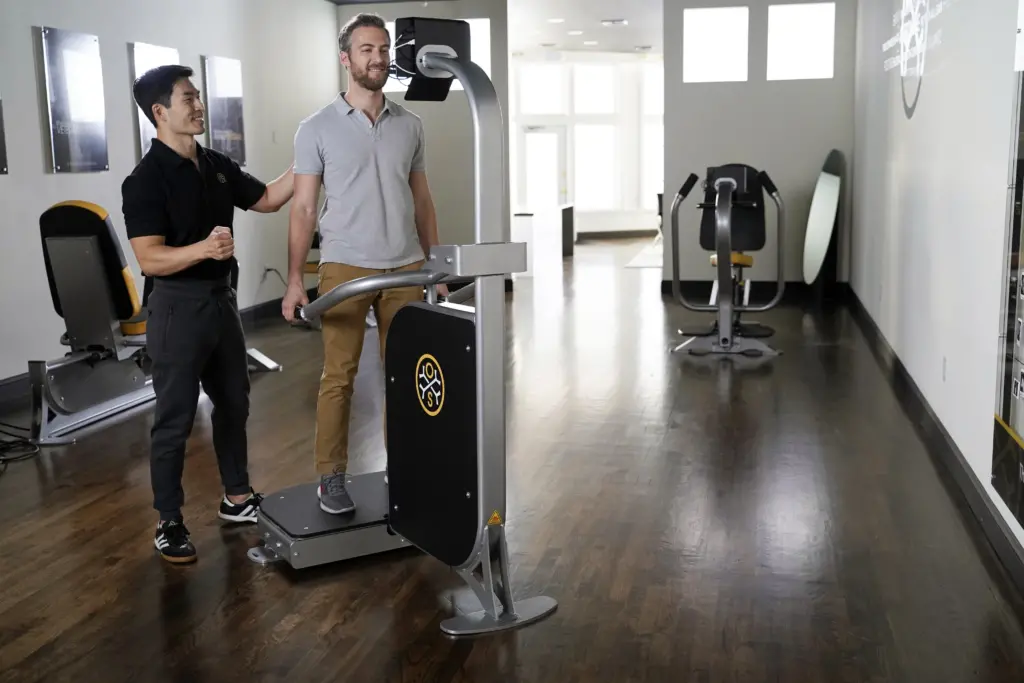
Each device positions you so the strongest part of a movement does the work. You decide how hard to push; a coach sets your position and watches your form every rep.
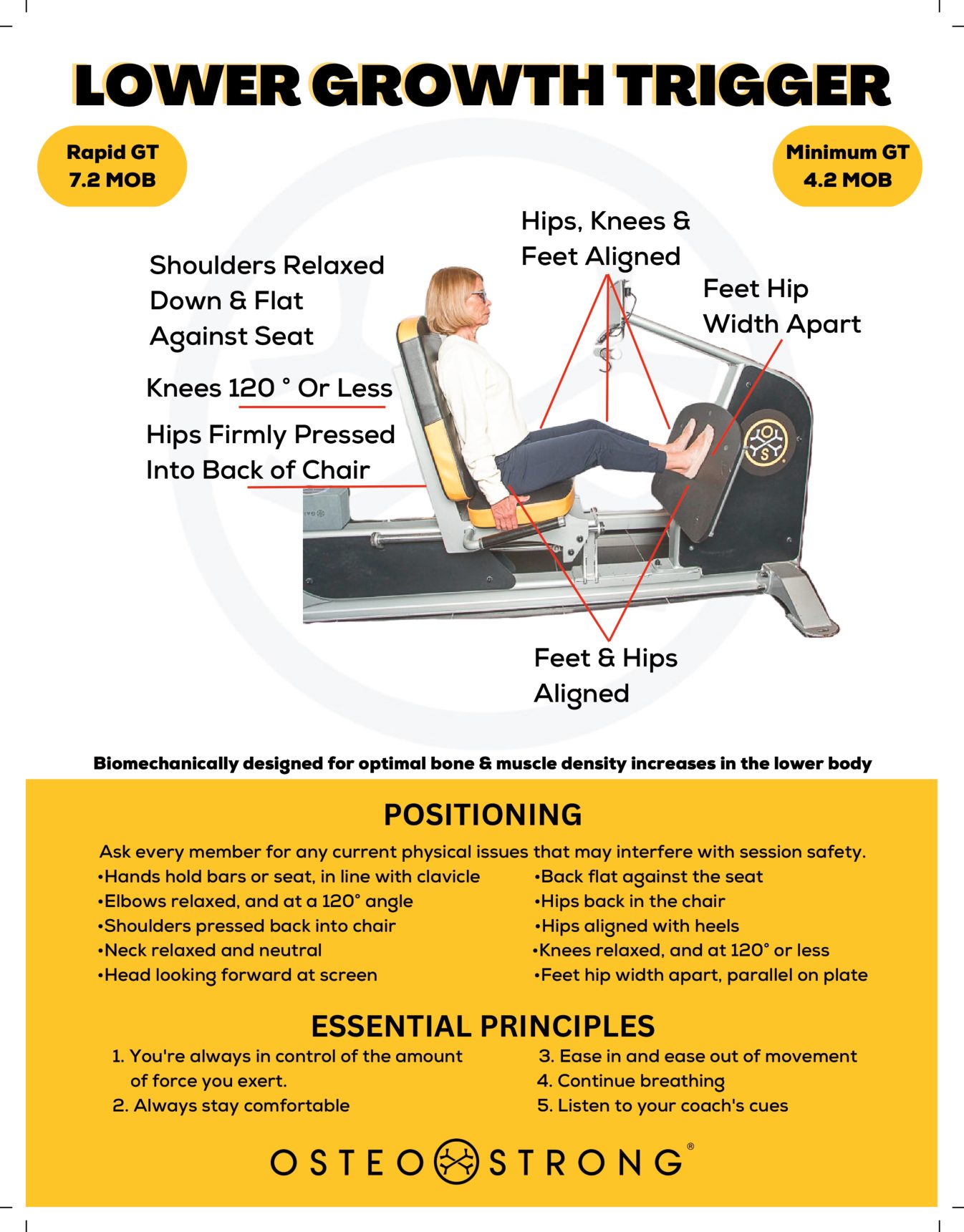
Lower Body
A leg-press position that sends load through the feet, legs and hips — the region most people come to us worried about.
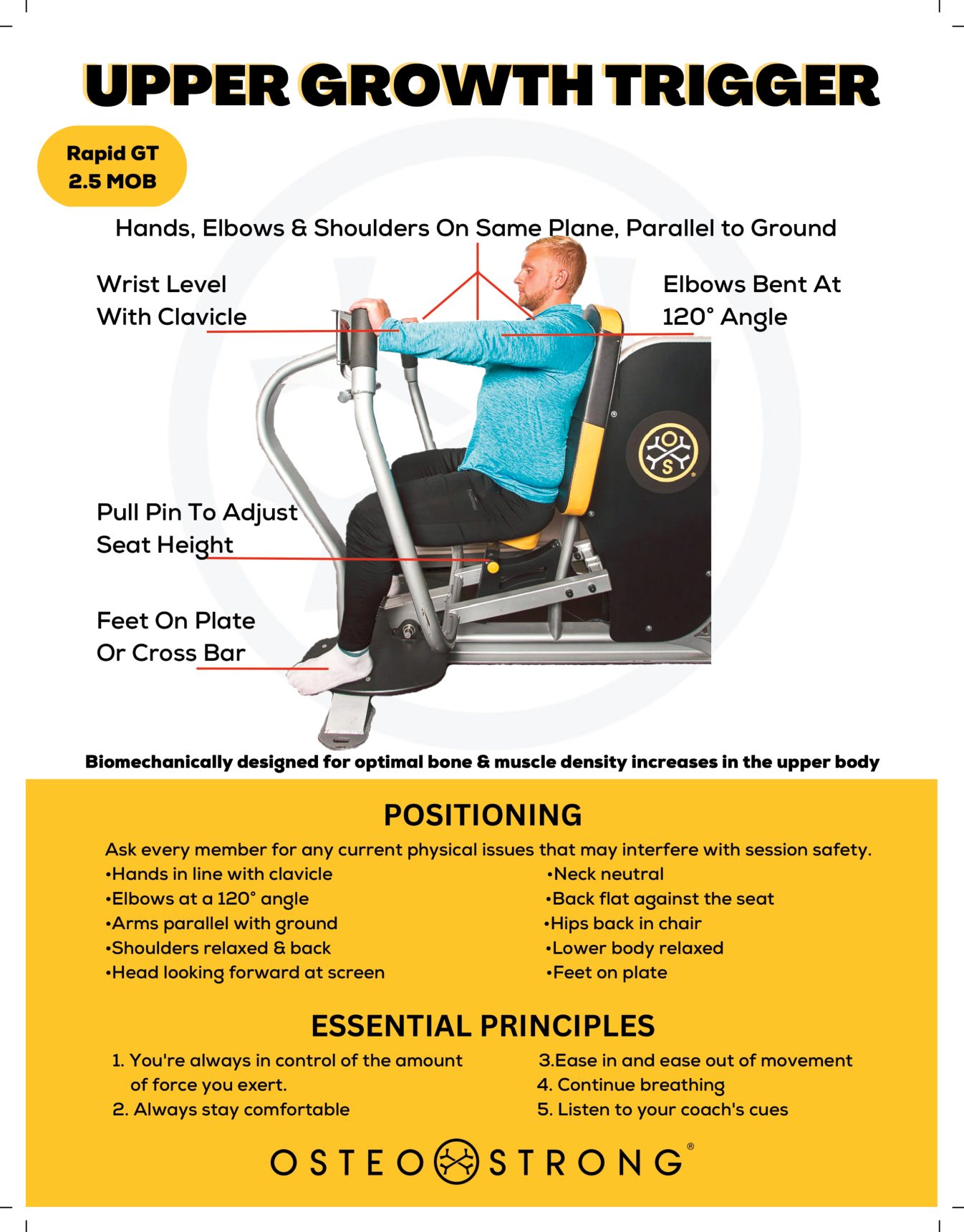
Upper Body
A chest-press position loading the hands, wrists, arms and shoulders through the upper kinetic chain.
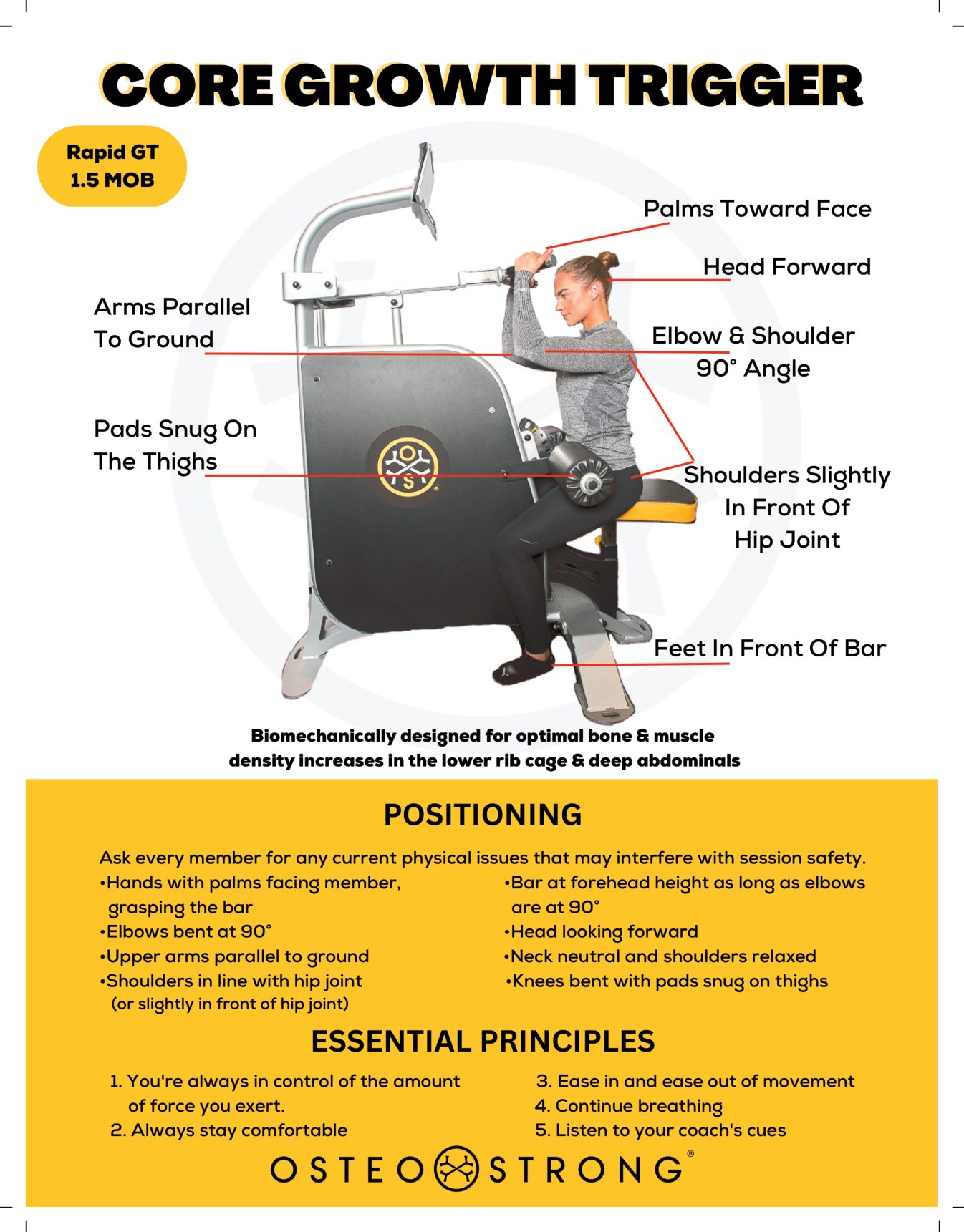
Core
A seated pull that engages the trunk and rib cage — the muscles that brace and protect the spine.
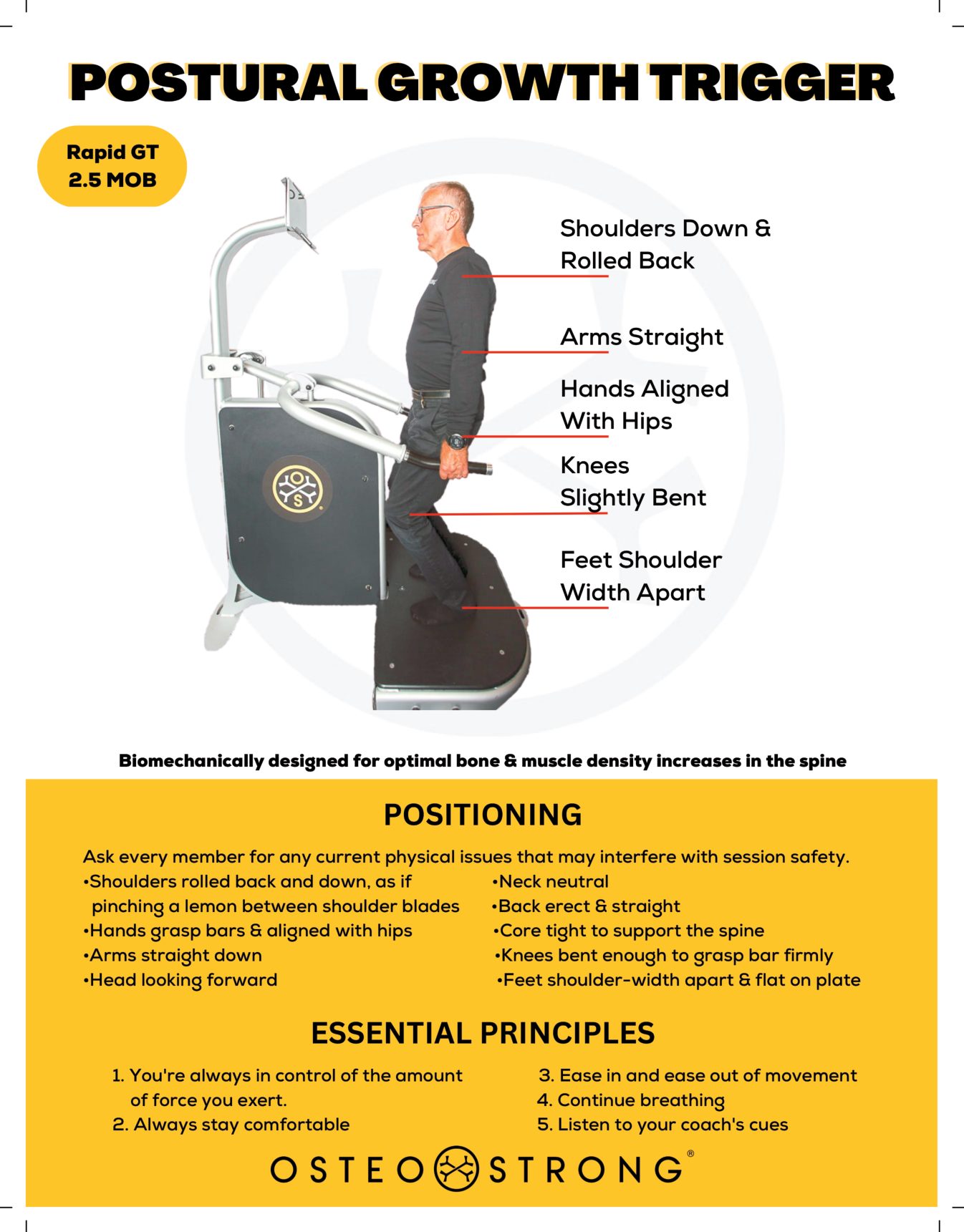
Postural
A standing deadlift-style position that loads the whole posterior chain and the vertebral column.
Ten Minutes. Fully Coached.
Nothing about a session resembles a gym. There are no reps to failure and nothing to lift. You move through the four devices with a coach beside you, then get on with your day. Many members pair it with VibePlate or a recovery modality in the same visit.
Check in, no changing
Come in your everyday clothes. No warm-up, no sweat, no locker room.
Coach positions you
Seat and handle positions are saved to your profile so every session starts from the same setup.
Push, build, hold, release
You ease into the push, build to a strong effort, hold briefly and ease out. Always under control, always your call.
See your numbers
Every device records your peak force, so you leave knowing how today compares with your own baseline.
Built for People Told to Be Careful
Because you control the force and nothing moves, osteogenic loading suits many people who can't or shouldn't lift heavy free weights. If you have an acute injury, recent surgery or an undiagnosed pain, talk to your physician first — we'll ask about it before you start.
Osteopenia or osteoporosis
Designed with low bone mass in mind: self-loaded, no impact, supervised. Keep your physician in the loop and keep taking what they prescribe.
Peri- and post-menopausal women
The years when bone loss speeds up are the years a strong loading stimulus is most worth having.
Adults who want to stay independent
Strength, balance and confidence on stairs, curbs and uneven ground — the things that keep life your own.
Athletes and active adults
A way to train at maximal intensity without the joint wear and recovery cost of maximal lifting.
People on a GLP-1 or losing weight
Rapid weight loss can take lean mass with it. A strong weekly loading stimulus is one way to defend it.
After physical therapy
PT gets you back to normal. Loading is about building capacity beyond normal, on an ongoing basis.
Your Numbers, Not an Average
Real bone change is slow — single-digit percentages over many months — so we track three different things on three different timescales. Force moves week to week, body composition over a few months, bone over a year or more.
Force output, every session
Each Spectrum device records the peak force you produce. Watching it climb against your own baseline is the most immediate evidence your body is adapting. It's a performance number — useful, but not a bone-density reading.
About the devicesREMS bone imaging
A radiation-free ultrasound bone density assessment of the spine and hip. Because there's no radiation, it can be repeated to track bone over time alongside your physician's DXA.
About REMSInBody body composition
Lean mass, fat mass and segmental muscle for each arm, leg and the trunk — so you can see whether you're holding or building the muscle that drives the load.
About InBodyWhat the Research Does and Doesn't Show
We lead with independent and peer-reviewed work, show the caveats, and include the trial that didn't go entirely our way.
LIFTMOR-M
Lumbar spine BMD over 8 months in men with osteopenia or osteoporosis using machine-based isometric axial compression — the same kind of loading our devices provide — versus controls.
OsteoStrong in Greece
Postmenopausal women with osteoporosis, 74 using the four-device circuit and 73 not, scanned by DXA over 12 months. Spine BMD improved in users with and without medication, and appeared to add to the effect of medication.
MelaOstrong
Real vs mock loading, each with or without melatonin, for a year. Only loading plus melatonin reached significance on spine BMD; loading alone did not, and there were no significant between-group differences.
What we don't claim
- We don't treat, cure or reverse osteoporosis. OsteoStrong is a wellness service, not medical care.
- No loading program — ours or anyone's — has been shown to prevent fractures.
- Loading is not a replacement for medication. Decisions about your prescription belong with your prescriber.
- Force readings show what your body can produce; they are not a measure of bone density.
Osteogenic Loading FAQ
What is osteogenic loading?
Osteogenic loading is brief, high-intensity, self-generated force applied through the skeleton in a fixed, supported position. At OsteoStrong you push against four Spectrum devices for a few seconds each, about ten minutes once a week, to give bone and muscle a strong signal to adapt.
Is it safe if I have osteoporosis or osteopenia?
The system was designed with low bone mass in mind: the handles don't move, there's no impact, you control how hard you push, and a coach sets your position. Talk to your physician before starting, keep taking any prescribed medication, and tell us about injuries or recent surgery so we can adjust.
Why only once a week?
Bone responds to the intensity of a load more than to how often you repeat it, and the adaptation happens in the days after the stimulus. A brief, strong session followed by recovery is the rhythm the program is built around.
Will I be sore or sweaty?
Most people aren't. There's no lifting, no repetitions to failure and no cardio, so you can come in your everyday clothes and go straight back to your day.
Can it replace my osteoporosis medication?
No. We never advise starting, stopping or changing a prescription — that decision belongs with your prescriber. Some research suggests loading and medication can work alongside each other, and we're happy to share your measurements with your doctor.
Feel What Ten Minutes Actually Asks of You
Your first visit includes a walkthrough of all four devices and your baseline force readings. If it isn't the right fit for you, we'll say so.