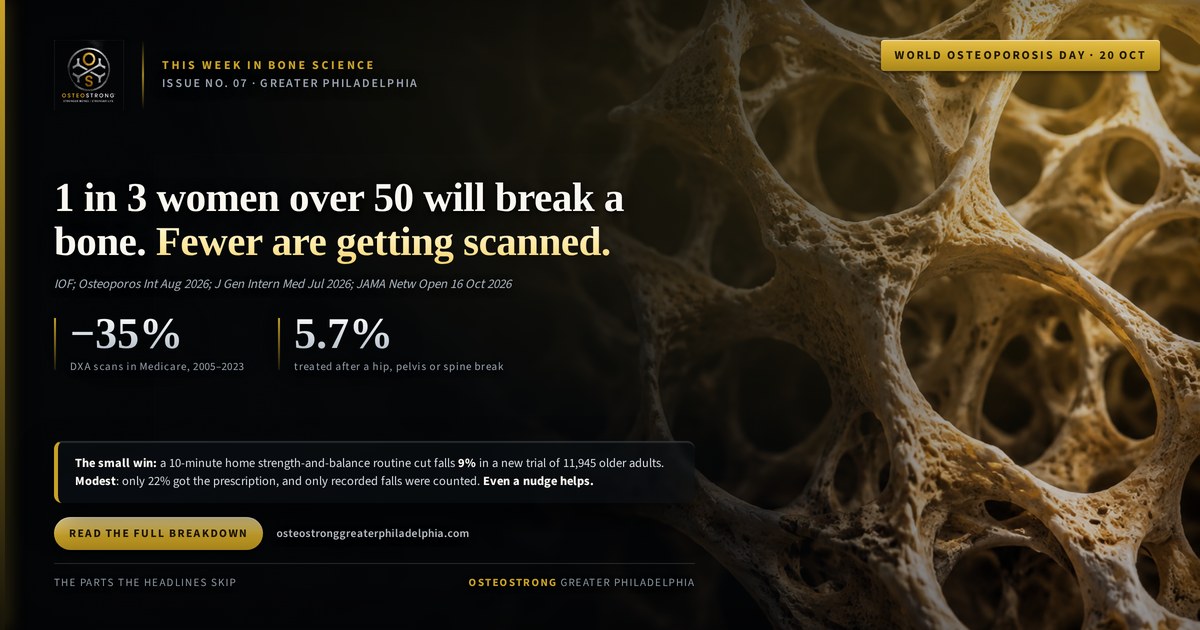
Tuesday, 20 October, is World Osteoporosis Day. This year’s theme from the International Osteoporosis Foundation is “Build, Protect, Strengthen Your Bones for Life.” It’s a good theme. So instead of a slogan, here are the real numbers behind it. Three of them are gaps, and one is a small piece of good news from a trial published last Friday.
First, the size of the problem. According to the IOF, 1 in 3 women and 1 in 5 men over 50 will break a bone because of osteoporosis. Most of them won’t know their bones were weak until it happens.
Gap 1: fewer people are getting scanned
A bone-density (DXA) scan is how you find out before a fracture does. But a study in Osteoporosis International this August found that DXA use among Medicare patients fell 35% between 2005 and 2023, from 7,255 to 4,690 scans per 100,000 people a year. The biggest drops were among Hispanic patients and people in poorer areas.
Gap 2: even after a break, very few get treated
A broken hip, pelvis or spine after a minor fall is a loud warning sign. In a study published in the Journal of General Internal Medicine this summer, researchers followed 9,849 adults over 50 who came to the emergency department with exactly that kind of fracture at 20 US hospitals. Of those who weren’t already on a bone medication, only 5.7% were started on one within six months.
Most people find out about their bones when something breaks. Then most of them still don’t get help.
The small win: a 10-minute routine and fewer falls
Now the good news. A trial published on 16 October in JAMA Network Open tested a simple idea. When an older patient screened positive for fall risk, their doctor’s computer showed a prompt to prescribe a home strength-and-balance routine. The routine takes about 10 minutes, needs no equipment, and is based on the well-studied Otago exercises.
The trial covered 11,945 adults over 65 (average age 77) at 22 primary care practices. Practices with the prompt recorded 19.3 falls per 100 patient-years versus 21.2, about 9% fewer. Fall injuries were about 6% lower too.
Still, that’s the encouraging part. Even a light nudge toward strength and balance, reaching only about 1 in 5 patients, moved the numbers. Falls are one of the leading causes of injury in older adults. Imagine what a real program does.
What to do with this today
Build: load your bones. Strength and impact are the signals bone responds to. Protect: work on your balance and leg strength, because most broken bones start with a fall. Strengthen: know your number. If you’re over 50, especially a woman after menopause, ask about a bone-density scan. And if you’ve already broken a bone in a minor fall, ask your doctor directly what your fracture-prevention plan is.
If you want the underlying mechanics — what bone density measures, what it misses, why load is the signal, and how to read your own report — that is what Boneprint Academy is for. 71 lessons, 890 citations, completely free, no signup required.
Open Boneprint AcademyFounder & CEO, Vital Edge Wellness · Owner, OsteoStrong Greater Philadelphia
Sources
- International Osteoporosis Foundation. Epidemiology of osteoporosis and fragility fractures; World Osteoporosis Day 2026: Build, Protect, Strengthen Your Bones for Life.
- Pelzl CE, Narayan AK, Prout TM, et al. Trends and disparities in DXA testing for osteoporosis among Medicare beneficiaries, 2005–2023. Osteoporosis International. Published online 6 August 2026. doi:10.1007/s00198-026-08083-6
- Silverstein WK, Mayrer BM, Stall NM, Zipursky JS, Anderson TS. Underprescribing of antifracture medications following non-traumatic fracture: a retrospective cohort study. J Gen Intern Med. Published online 31 July 2026. doi:10.1007/s11606-026-10659-1
- Latham NK, Hommel EL, Kiesman J, et al. Clinical decision support for fall prevention in primary care (eSTEPS). JAMA Network Open. 16 October 2026. doi:10.1001/jamanetworkopen.2026.39240
- Mercer C. Older adults at fall risk had modestly fewer falls when clinics could prescribe home strength and balance exercises. Medical Daily, 18 October 2026.