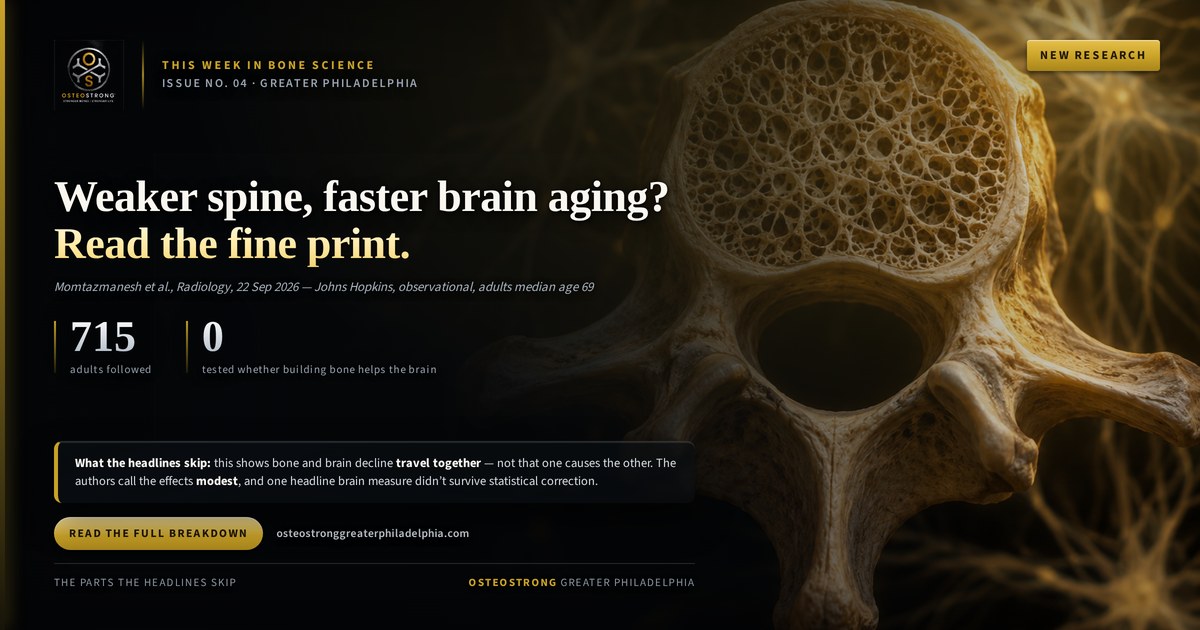
Over the weekend a headline went round: weaker spinal bones may signal faster brain aging. It comes from a real study, published on 22 September in Radiology by a team at Johns Hopkins, and it is worth reading properly — because what it found is interesting, and what it didn’t find is the part that matters for you.
The researchers went back to the Multi-Ethnic Study of Atherosclerosis, a long-running US study originally set up to track heart disease. They took 715 adults, median age 69, with no known heart disease, who had had a chest CT scan, brain MRI and memory testing. An AI algorithm read the density of the spine bones straight off the chest CT. Then the team followed the brain scans and cognitive scores over the next several years.
People who started with lower spine bone density showed faster decline on a global measure of thinking and memory, and on a standard cognitive screening test. On MRI, lower bone density went with faster wear in two specific regions of the brain’s white matter — the wiring that connects different areas. The link was stronger in people with diabetes.
So what does it tell you? Mainly that bone density is not just a fracture number. It appears to track, in a modest way, how the rest of the body is ageing — which is one more reason to know your own number, and one more reason the habits that protect bone (moving, loading, staying metabolically healthy) are rarely about bone alone.
A bone scan may be telling you about more than your bones. That is not the same as a bone treatment protecting your brain.
Cochrane: the complicated falls programmes don’t beat the simple ones
The second paper is less viral and probably more useful. On 21 September, Cochrane — the gold standard for pooling clinical trials — updated its review of falls-prevention programmes for older people living at home. Led by the University of Exeter, it now covers 110 randomised trials and 48,919 people aged 60 and over.
It looked at two kinds of programme. Tailored (“multifactorial”) programmes assess each person’s risk factors and build a plan around them — medication review, vision, home hazards, exercise. Bundled (“multiple component”) programmes give everyone the same package.
Against usual care, tailored programmes may reduce the number of falls by about a quarter (rate ratio 0.76) and slightly reduce repeat falls — but they made little or no difference to whether someone fell at all. Against simple falls advice or education, they gave no additional benefit, and may even have been associated with slightly more falls (rate ratio 1.09, moderate-certainty evidence). The bundled programmes likely made little or no difference to the risk of falling when compared with exercise alone.
The practical read is refreshingly simple. When programmes that cost more and do more fail to beat good advice and regular exercise, the basics deserve more of your effort than the extras.
Not falling is a skill. The evidence keeps pointing back to practising it.
Where this leaves you
Two honest conclusions this week. Lower bone density travels with faster brain ageing — modestly, in one observational study, with no evidence yet that fixing one fixes the other. And the biggest review of falls programmes to date says the elaborate, personalised versions don’t reliably beat the simple ones.
Neither paper gives anyone licence to promise you a sharper brain or a fall-proof year. Both are good reasons to keep your skeleton loaded, your muscles working and your balance practised.
If you want the underlying mechanics — what bone density measures, what it misses, why load is the signal, and how to read your own report — that is what Boneprint Academy is for. 71 lessons, 890 citations, completely free, no signup required.
Open Boneprint AcademyFounder & CEO, Vital Edge Wellness · Owner, OsteoStrong Greater Philadelphia
Sources
- Momtazmanesh S, Hathaway QA, Bancks MP, et al. Deep learning–derived bone mineral density and longitudinal white matter microstructure and cognitive decline: Multi-Ethnic Study of Atherosclerosis. Radiology 2026;320(3):e260656. Published 22 September 2026. doi:10.1148/radiol.260656
- Swarnalatha C, Wood L, Newell P, et al. Multifactorial and multiple component interventions for preventing falls in older people living in the community. Cochrane Database Syst Rev 2026;9:CD012221. Published 21 September 2026. doi:10.1002/14651858.CD012221.pub3